

1. At a glance
| Property | Tesamorelin | Ipamorelin |
|---|---|---|
| Length | 44 residues | 5 residues |
| Sequence basis | GHRH(1–44) with an N-terminal trans-3-hexenoyl group | Aib-His-D-2-Nal-D-Phe-Lys-NH2 |
| Approx. molecular weight | ≈5,136 Da | ≈712 Da |
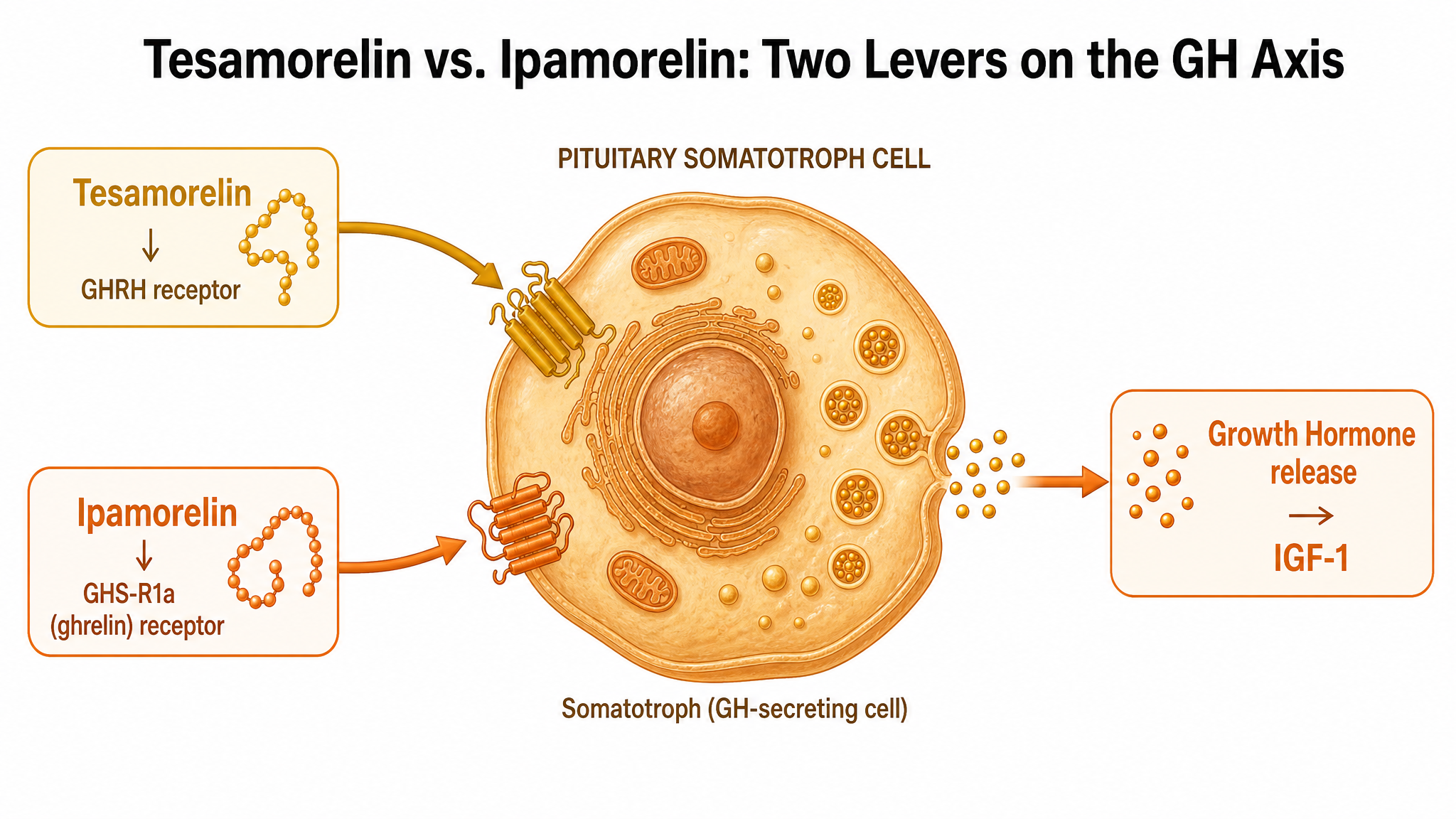
| Receptor | GHRH receptor | GHS-R1a |
| Other names | TH9507 | NNC 26-0161 |
2. Tesamorelin
Tesamorelin reproduces the full 44-residue GHRH sequence with one modification: a trans-3-hexenoyl group attached to the N-terminal tyrosine. That addition protects the N-terminus from cleavage by dipeptidyl peptidase-4, which rapidly shortens the unmodified sequence. It acts as a GHRH-receptor agonist, a class B G-protein-coupled receptor.
3. Ipamorelin
Ipamorelin was first described by Raun and colleagues at Novo Nordisk in 1998. It is built from non-proteinogenic and D-configured residues — α-aminoisobutyric acid (Aib), D-2-naphthylalanine and D-phenylalanine — and carries a C-terminal amide. These features give it a compact structure and resistance to common peptidases. Its receptor is GHS-R1a, a class A G-protein-coupled receptor; the original report highlighted its selectivity for that receptor compared with earlier compounds of the same family.
4. The CJC-1295 blend
A combined vial of tesamorelin, ipamorelin and CJC-1295 (no DAC) is also offered. CJC-1295 without DAC is a modified 29-residue GHRH analog, sometimes called modified GRF(1–29), with four amino-acid substitutions that increase resistance to enzymatic cleavage.
5. Analytical characterization
Identity and purity are confirmed analytically for every lot. Reversed-phase HPLC with UV detection quantifies chromatographic purity, and electrospray mass spectrometry (ESI-MS) confirms that the observed molecular mass matches the theoretical value for each compound.
For a multi-component vial, each constituent elutes as a separate chromatographic peak. The relative peak areas are compared against the labeled mass ratio, so the certificate of analysis can be checked constituent by constituent rather than as a single total.
Results are reported on a lot-specific certificate of analysis together with appearance, net content and the lot number, which allows any vial to be traced back to its analytical record.
6. Storage and handling
Material is supplied as a lyophilized solid in a sealed vial. Unopened vials are best kept at −20 °C, protected from light and moisture. Allow a vial to equilibrate to room temperature before opening to limit condensation, and record the lot number so the vial can be matched to its certificate of analysis.
A lot-specific certificate of analysis is available for each batch.
Research Use Only. All products sold by ShortChain Aminos are intended strictly for laboratory research purposes. They are not for human or veterinary use, and nothing in this article constitutes medical advice, usage instructions, or a recommendation of any kind. This content summarizes published third-party research for informational purposes only.