

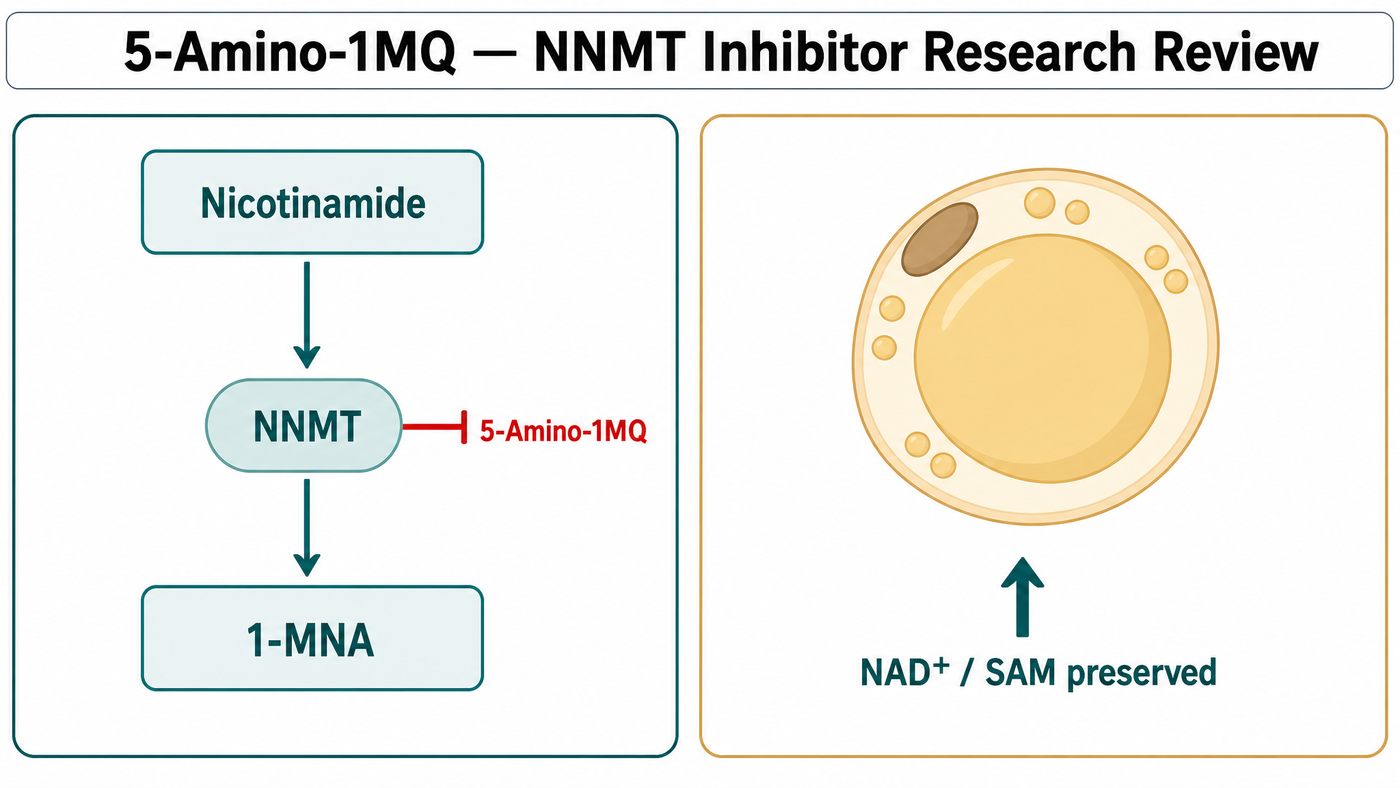
1. Chemical identity
| Property | Detail |
|---|---|
| Name | 5-Amino-1-methylquinolinium (5-amino-1MQ, 5A1MQ) |
| Chemical class | N-methylquinolinium cation |
| Cation formula | C10H11N2+ |
| Approximate mass (cation) | ≈159.2 g/mol |
| Target | Nicotinamide N-methyltransferase (NNMT) |
| Type | Small organic molecule; not an amino-acid chain |
Because the ring nitrogen is methylated, the molecule carries a permanent positive charge and is usually supplied as a salt; the counter-ion should be taken into account when converting between salt mass and cation mass.
2. Discovery through structure-activity work
5-Amino-1MQ emerged from a structure-activity relationship (SAR) program led by Stanley Watowich and colleagues at the University of Texas Medical Branch, with collaborators at UT San Antonio. Their 2017 Journal of Medicinal Chemistry paper (Neelakantan et al.) screened a series of quinolinium analogs against NNMT and identified the 5-amino substituted compound among the more potent and selective members.
3. The target enzyme: NNMT
NNMT transfers a methyl group from S-adenosylmethionine (SAM) to nicotinamide, producing 1-methylnicotinamide (1-MNA) and S-adenosylhomocysteine. Because the reaction consumes both nicotinamide and SAM, the enzyme sits at a junction between NAD+ precursor availability and cellular methylation capacity. Pissios (2017) reviews why NNMT is now regarded as more than a simple vitamin B3 clearance enzyme. 5-Amino-1MQ occupies the nicotinamide-binding site, which is consistent with its structural similarity to the methylated product.
4. Analytical characterization
Identity and purity are confirmed analytically for every lot. Reversed-phase HPLC with UV detection quantifies chromatographic purity, and electrospray mass spectrometry (ESI-MS) confirms that the observed molecular mass matches the theoretical value for 5-amino-1MQ.
For small organic molecules, proton NMR is a common complement to HPLC and MS, confirming the substitution pattern of the aromatic ring system.
Results are reported on a lot-specific certificate of analysis together with appearance, net content and the lot number, which allows any vial to be traced back to its analytical record.
5. Storage and handling
Small-molecule solids of this class are typically kept dry, desiccated and protected from light at −20 °C. Containers should be tightly closed and brought to room temperature before opening to limit condensation.
Sources
- Neelakantan H, Wang HL, Vance V, et al. Structure-Activity Relationship for Small Molecule Inhibitors of Nicotinamide N-Methyltransferase. J Med Chem. 2017;60(12):5015-5028. doi:10.1021/acs.jmedchem.7b00389. PMID: 28548833. PubMed.
- Pissios P. Nicotinamide N-Methyltransferase: More Than a Vitamin B3 Clearance Enzyme. Trends Endocrinol Metab. 2017;28(5):340-353. doi:10.1016/j.tem.2017.02.004. PMID: 28291578. PubMed.