

1. Chemical identity
| Property | Detail |
|---|---|
| Name | SLU-PP-332 |
| Chemical class | Aryl acyl-hydrazone (benzohydrazide) |
| Systematic name | (E)-4-hydroxy-N′-(naphthalen-2-ylmethylene)benzohydrazide |
| Molecular formula | C18H14N2O2 |
| Approximate molecular weight | ≈290.3 g/mol |
| Targets | ERRα (ESRRA), ERRβ (ESRRB), ERRγ (ESRRG) |
2. Design and naming
SLU-PP-332 was first described in 2023 in ACS Chemical Biology by Cyrielle Billon, Thomas Burris and colleagues at Saint Louis University — the source of the “SLU” prefix — with collaborators including the Salk Institute. The compound was developed by structure-based design, building on the acyl-hydrazone scaffold of the earlier ERRβ/γ agonist GSK4716 and modifying it to occupy the ligand-binding pocket of ERRα as well.
The original publication used the descriptive term “exercise mimetic” for the gene-expression pattern it observed in cell and animal models; that label has stayed attached to the compound in later literature.
3. The estrogen-related receptors
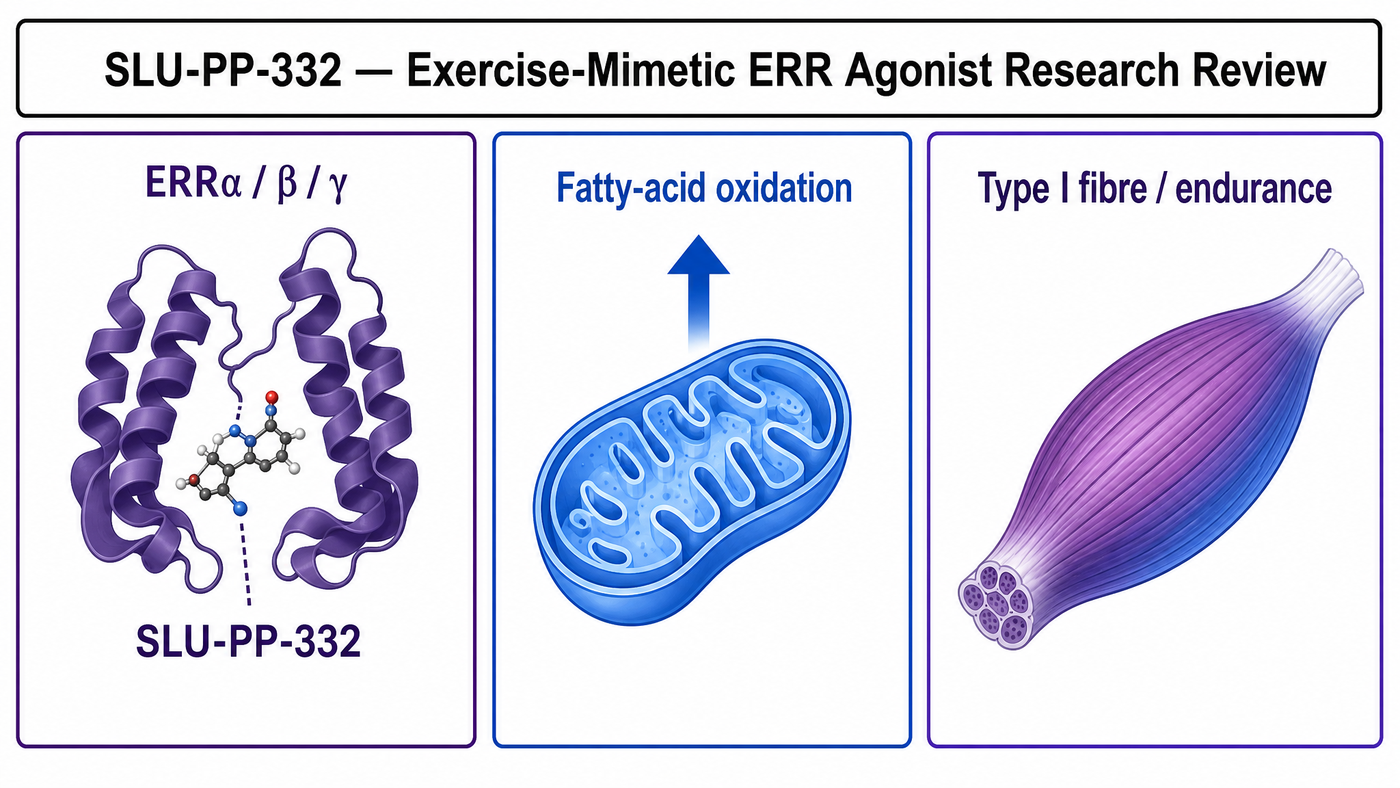
ERRα, ERRβ and ERRγ are orphan nuclear receptors: they share sequence similarity with the estrogen receptors but do not bind estradiol, and no endogenous ligand has been confirmed. They act as transcription factors that are constitutively active and work with coactivators such as PGC-1α. Synthetic agonists like SLU-PP-332 are tools for probing how ligand occupancy changes that baseline activity.
Reported EC50 values place SLU-PP-332 in the nanomolar range at ERRα, with lower potency at ERRβ and ERRγ, which is why it is described as a pan-agonist with ERRα preference.
4. Later chemical optimization
Follow-up medicinal chemistry has explored the scaffold further. Related compounds such as SLU-PP-915 were reported by the same group, and a 2026 study by Okda and colleagues described a chemical optimization of SLU-PP-332 aimed at clarifying how ERR signaling responds to structural changes in the ligand.
5. Analytical characterization
Identity and purity are confirmed analytically for every lot. Reversed-phase HPLC with UV detection quantifies chromatographic purity, and electrospray mass spectrometry (ESI-MS) confirms that the observed molecular mass matches the theoretical value for SLU-PP-332.
For small organic molecules, proton NMR is a common complement to HPLC and MS, confirming the substitution pattern of the aromatic ring system.
Results are reported on a lot-specific certificate of analysis together with appearance, net content and the lot number, which allows any vial to be traced back to its analytical record.
6. Storage and handling
Small-molecule solids of this class are typically kept dry, desiccated and protected from light at −20 °C. Containers should be tightly closed and brought to room temperature before opening to limit condensation.
Sources
- Okda HE, et al. Chemical optimization of the exercise mimetic SLU-PP-332 enables insight into estrogen-related receptor signaling. Int J Biol Macromol. 2026;355:151450. doi:10.1016/j.ijbiomac.2026.151450. PMID: 41850449. PubMed.