

1. Identity and structure
| Property | Detail |
|---|---|
| Name | Selank |
| Sequence | Thr-Lys-Pro-Arg-Pro-Gly-Pro (TKPRPGP) |
| Length | 7 residues |
| Approx. molecular weight | ≈751 Da |
| Parent sequence | Tuftsin (Thr-Lys-Pro-Arg) |
2. Design rationale
Tuftsin is a short sequence released from the Fc region of IgG. On its own it is cleaved quickly by peptidases. Selank extends tuftsin at the C-terminus with the three-residue motif Pro-Gly-Pro, a proline-rich unit that slows enzymatic breakdown. The same Pro-Gly-Pro extension strategy was used for Semax.
3. Origin
Selank was developed at the Institute of Molecular Genetics of the Russian Academy of Sciences in Moscow, the same institute responsible for Semax. Most of the published literature on the compound comes from Russian groups.
4. Molecular studies
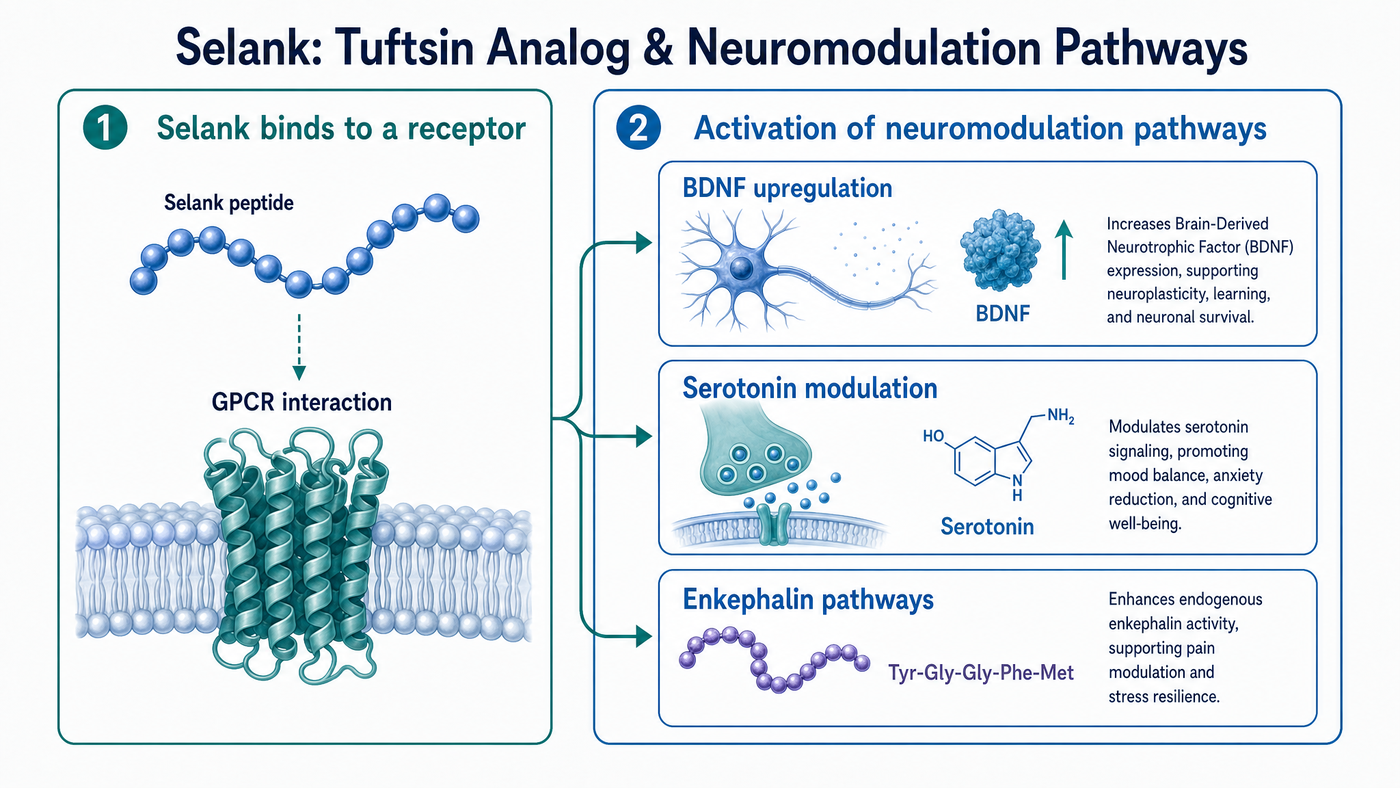
Filatova and colleagues (2017) examined Selank in IMR-32 neuroblastoma cells and reported changes in the expression of genes belonging to the GABAergic system. Zolotarev and colleagues (2001) reported that Selank and Semax inhibit enkephalin-degrading enzymes in human serum, and a companion study mapped which Selank fragments carry that inhibitory activity.
5. Analytical characterization
Identity and purity are confirmed analytically for every lot. Reversed-phase HPLC with UV detection quantifies chromatographic purity, and electrospray mass spectrometry (ESI-MS) confirms that the observed molecular mass matches the theoretical value for Selank.
Results are reported on a lot-specific certificate of analysis together with appearance, net content and the lot number, which allows any vial to be traced back to its analytical record.
6. Storage and handling
Material is supplied as a lyophilized solid in a sealed vial. Unopened vials are best kept at −20 °C, protected from light and moisture. Allow a vial to equilibrate to room temperature before opening to limit condensation, and record the lot number so the vial can be matched to its certificate of analysis.
A lot-specific certificate of analysis is available for each batch.
Sources
- Filatova E, et al. GABAergic system genes and Selank in IMR-32 neuroblastoma cells. Front Pharmacol. 2017. doi:10.3389/fphar.2017.00089. PMID: 28326021. PubMed.
- Zolotarev YA, et al. Semax and Selank inhibit the enkephalin-degrading enzymes of human serum. 2001. PMID: 11550013. PubMed.
- Zolotarev YA, et al. Structural requirements for enkephalinase inhibition by Selank fragments. 2001. PMID: 11443939. PubMed.