
1. Identity
| Property | Detail |
|---|---|
| Names | GHK-Cu, glycyl-L-histidyl-L-lysine copper(II) |
| Sequence | Gly-His-Lys |
| Approx. molecular weight | ≈340 Da (GHK); ≈404 Da (Cu complex) |
| Appearance | Blue to blue-violet solid |
2. Discovery
GHK was identified in 1973 by Loren Pickart, who isolated it from human plasma albumin fractions and found that it binds copper with high affinity. Much of the subsequent literature concerns the copper complex rather than the free sequence.
3. Copper coordination chemistry
At neutral pH, Cu(II) is held by three nitrogen donors: the free N-terminal amino group of glycine, the deprotonated amide nitrogen between glycine and histidine, and the imidazole nitrogen of histidine. A fourth position can be occupied by a carboxylate from a neighboring molecule or by water. This arrangement explains the high affinity and the d–d absorption band responsible for the blue color. The lysine side chain is not part of the copper site and remains available for interactions with other molecules; keratinocyte studies such as Kang et al. (2009) used the complex as a defined copper source.
4. Formulation and stability considerations
The complex is sensitive to strong chelators (such as EDTA), which can strip the copper, and to strongly acidic conditions that protonate the coordinating nitrogens. Reducing agents can convert Cu(II) to Cu(I), changing color and binding. Conjugation strategies, such as attaching GHK to hyaluronan as described by Greco and colleagues, have been explored to change how the copper complex is presented and released.
5. Analytical characterization
Identity and purity are confirmed analytically for every lot. Reversed-phase HPLC with UV detection quantifies chromatographic purity, and electrospray mass spectrometry (ESI-MS) confirms that the observed molecular mass matches the theoretical value for GHK and its copper complex.
Results are reported on a lot-specific certificate of analysis together with appearance, net content and the lot number, which allows any vial to be traced back to its analytical record.
6. Storage and handling
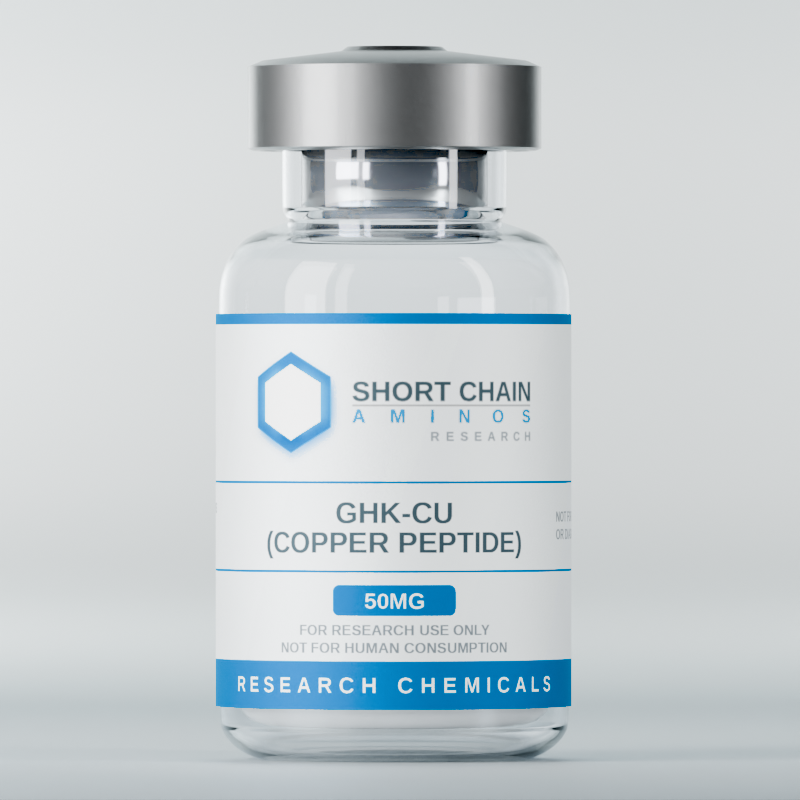
Material is supplied as a lyophilized solid in a sealed vial. Unopened vials are best kept at −20 °C, protected from light and moisture. Allow a vial to equilibrate to room temperature before opening to limit condensation, and record the lot number so the vial can be matched to its certificate of analysis.
A lot-specific certificate of analysis is available for each batch.
Sources
- Kang YA, Choi HR, Na JI, et al. Copper-GHK increases integrin expression and p63 positivity by keratinocytes. Arch Dermatol Res. 2009. doi:10.1007/s00403-009-0942-x. PMID: 19319546. PubMed.
- Greco V, Lanza V, Tomasello B, et al. Copper Complexes with New Glycyl-l-histidyl-l-lysine-Hyaluronan Conjugates Show Antioxidant Properties and Osteogenic and Angiogenic Synergistic Effects. Bioconjug Chem. 2025. doi:10.1021/acs.bioconjchem.4c00545. PMID: 40123442. PubMed.
Research Use Only. All products sold by ShortChain Aminos are intended strictly for laboratory research purposes. They are not for human or veterinary use, and nothing in this article constitutes medical advice, usage instructions, or a recommendation of any kind. This content summarizes published third-party research for informational purposes only.