

1. Identity and structure
| Property | Detail |
|---|---|
| Common names | Thymosin alpha-1, Tα1, thymalfasin (Zadaxin) |
| Length | 28 amino acids |
| Sequence | Ac-SDAAVDTSSEITTKDLKEKKEVVEEAEN |
| N-terminus | Acetylated serine |
| Approximate molecular weight | ≈3,108 Da |
| Origin of the sequence | N-terminal fragment of prothymosin alpha |
The sequence is strongly acidic, carrying a large number of glutamate and aspartate residues, which gives the molecule a pronounced net negative charge at neutral pH. The acetyl group on the N-terminal serine is part of the native structure and is reproduced in synthetic material.
2. Discovery and nomenclature
Thymosin alpha-1 was first identified in the 1970s by Allan Goldstein and colleagues as one component of “thymosin fraction 5,” a partially purified extract of calf thymus gland. Fraction 5 turned out to be a mixture of many small acidic proteins, which were named alpha, beta and gamma thymosins according to their isoelectric behavior. Tα1 was the first of these to be sequenced.
It was later recognized that Tα1 corresponds to the first 28 residues of a larger precursor, prothymosin alpha, which is expressed in many cell types rather than in the thymus alone. Chemically synthesized material received the international nonproprietary name thymalfasin.
3. Conformation in solution
Structural studies describe Tα1 as largely disordered in water. In membrane-mimetic environments, such as trifluoroethanol mixtures or lipid micelles, it adopts helical structure over part of its length. This environment-dependent folding is typical of short, highly charged sequences and is summarized in the structural review by Hoch and Volk.
4. Reported receptor interactions
In the molecular literature, Tα1 is most often discussed in connection with Toll-like receptors, a family of pattern-sensing receptors, with TLR2 and TLR9 the members most frequently named. These reports describe binding and downstream signaling events in cell systems; they are presented here only as part of the compound’s molecular description.
5. Analytical characterization
Identity and purity are confirmed analytically for every lot. Reversed-phase HPLC with UV detection quantifies chromatographic purity, and electrospray mass spectrometry (ESI-MS) confirms that the observed molecular mass matches the theoretical value for thymosin alpha-1.
Results are reported on a lot-specific certificate of analysis together with appearance, net content and the lot number, which allows any vial to be traced back to its analytical record.
6. Storage and handling
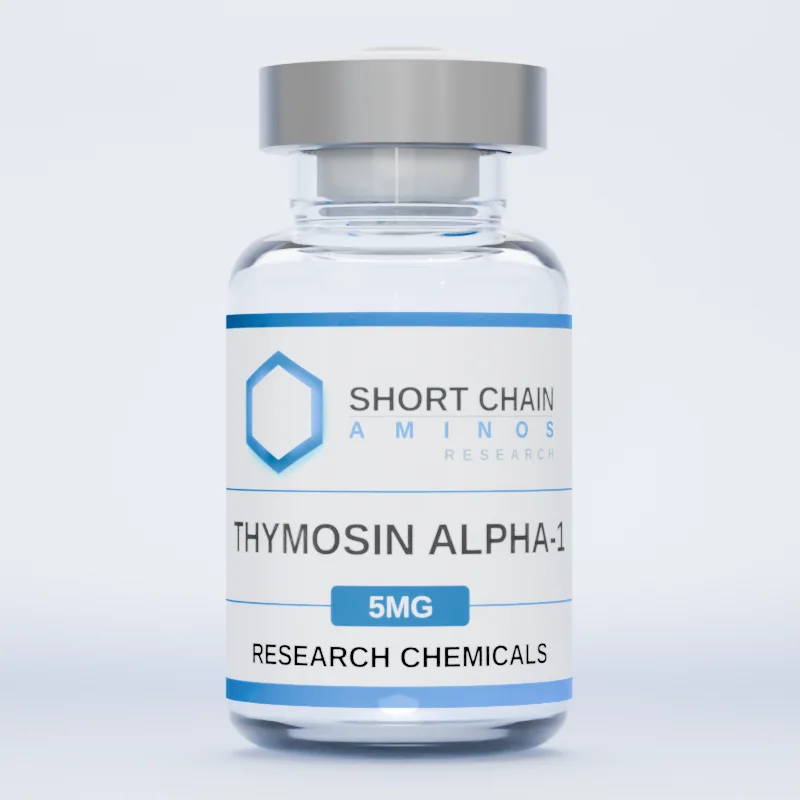
Material is supplied as a lyophilized solid in a sealed vial. Unopened vials are best kept at −20 °C, protected from light and moisture. Allow a vial to equilibrate to room temperature before opening to limit condensation, and record the lot number so the vial can be matched to its certificate of analysis.
A lot-specific certificate of analysis is available for each batch.
Sources
Research Use Only. All products sold by ShortChain Aminos are intended strictly for laboratory research purposes. They are not for human or veterinary use, and nothing in this article constitutes medical advice, usage instructions, or a recommendation of any kind. This content summarizes published third-party research for informational purposes only.