

1. At a glance
| Molecule | Type | Composition | Approx. MW |
|---|---|---|---|
| MOTS-c | 16-residue sequence | MRWQEMGYIFYPRKLR | ≈2,175 Da |
| NAD+ | Dinucleotide cofactor | C21H27N7O14P2 | ≈663.4 g/mol |
| SS-31 | 4-residue synthetic sequence | D-Arg-Dmt-Lys-Phe-NH2 | ≈640 Da |
2. MOTS-c
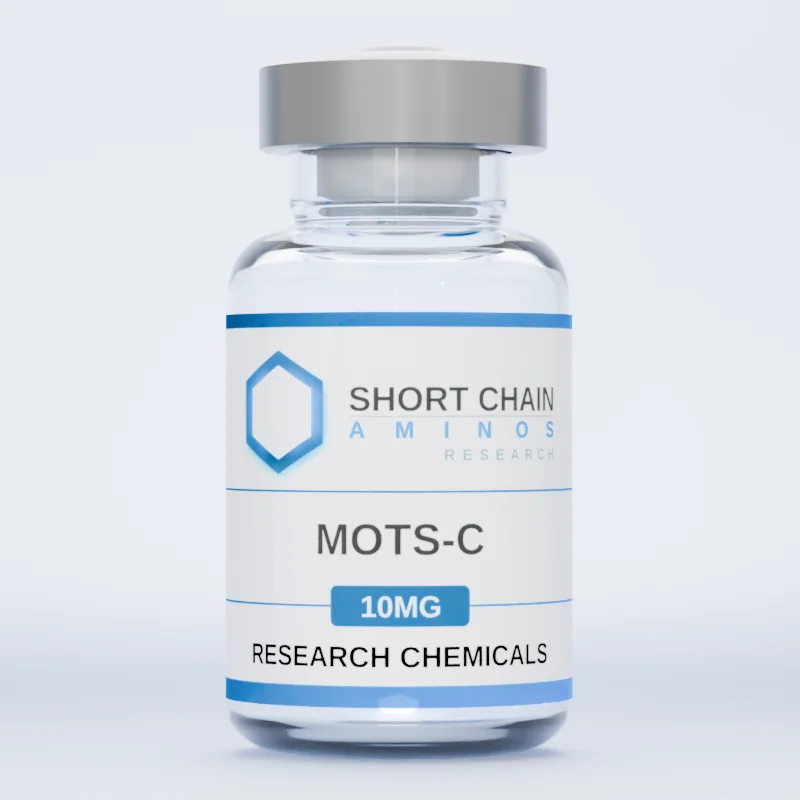
MOTS-c was described in 2015 by Changhan Lee, Pinchas Cohen and colleagues. Its short open reading frame lies within the 12S rRNA region of the organelle genome, which makes it one of a small group of sequences encoded outside the nucleus. The name is an acronym of that origin (the “open reading frame of the 12S rRNA-c”).
3. NAD+
Nicotinamide adenine dinucleotide consists of two nucleotides — nicotinamide mononucleotide and adenosine monophosphate — joined through their phosphate groups. It cycles between an oxidized form (NAD+) and a reduced form (NADH) as an electron carrier in redox reactions, and it is consumed as a substrate by enzyme families including sirtuins, PARPs and CD38. Its biosynthesis and the many unanswered questions about its biology are reviewed by Bhasin and colleagues (2023).
4. SS-31
SS-31 (elamipretide) is a member of the Szeto-Schiller series of aromatic-cationic sequences. It binds diphosphatidylglycerol, an anionic phospholipid of the organelle’s inner membrane, and a 2024 CRISPR screen identified phospholipid scramblase 3 (PLSCR3) as its protein target.
5. Analytical characterization
Identity and purity are confirmed analytically for every lot. Reversed-phase HPLC with UV detection quantifies chromatographic purity, and electrospray mass spectrometry (ESI-MS) confirms that the observed molecular mass matches the theoretical value for each molecule.
Results are reported on a lot-specific certificate of analysis together with appearance, net content and the lot number, which allows any vial to be traced back to its analytical record.
6. Storage and handling
Material is supplied as a lyophilized solid in a sealed vial. Unopened vials are best kept at −20 °C, protected from light and moisture. Allow a vial to equilibrate to room temperature before opening to limit condensation, and record the lot number so the vial can be matched to its certificate of analysis.
A lot-specific certificate of analysis is available for each batch.
Research Use Only. All products sold by ShortChain Aminos are intended strictly for laboratory research purposes. They are not for human or veterinary use, and nothing in this article constitutes medical advice, usage instructions, or a recommendation of any kind. This content summarizes published third-party research for informational purposes only.