

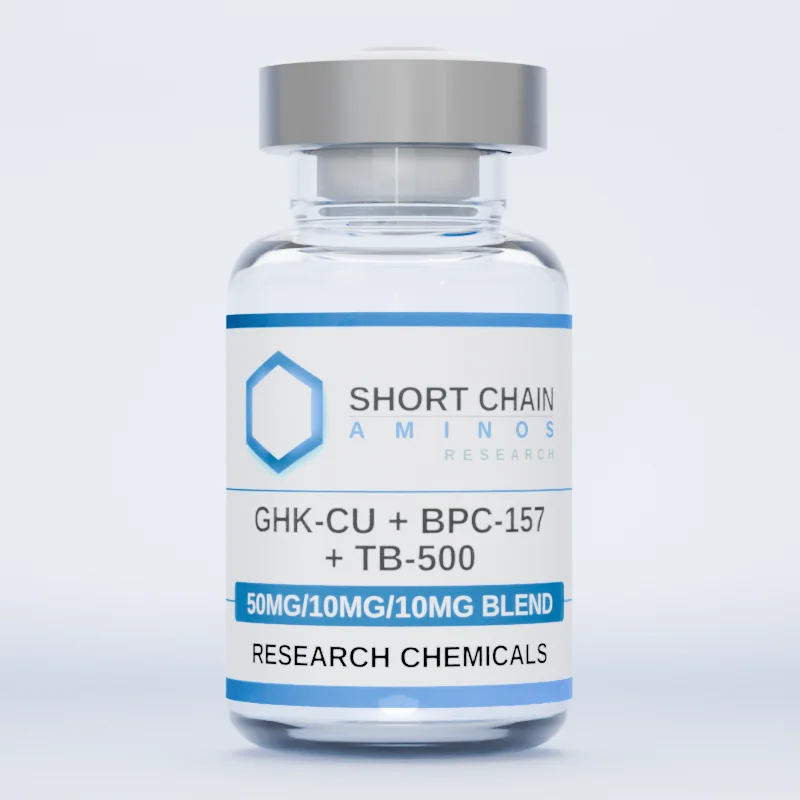
1. The three molecules at a glance
| Compound | Sequence / composition | Approx. MW | Origin |
|---|---|---|---|
| GHK-Cu | Gly-His-Lys complexed with Cu(II) | ≈404 Da (complex) | Identified in human plasma by Loren Pickart, 1973 |
| BPC-157 | GEPPPGKPADDAGLV (15 residues) | ≈1,419 Da | Partial sequence of a protein isolated from gastric juice |
| TB-500 | Synthetic fragment of thymosin β4, centred on LKKTETQ | varies by definition | Derived from the actin-binding region of thymosin β4 |
2. GHK-Cu: a copper-binding sequence
GHK (glycyl-L-histidyl-L-lysine) has a high affinity for Cu(2+). The copper ion is coordinated by the N-terminal amino nitrogen, a deprotonated backbone amide nitrogen and the imidazole nitrogen of histidine, which gives the complex its characteristic blue tint. GHK can deliver copper as a cofactor to copper-dependent enzymes such as lysyl oxidase.
3. BPC-157: a 15-residue sequence of gastric origin
BPC-157 is a 15-residue sequence studied largely by the group of Predrag Sikirić in Zagreb. It corresponds to part of a larger protein first isolated from gastric juice, and the name stands for “body protection compound.” It is notable for its stability in acidic conditions compared with many sequences of similar length.
4. TB-500 and thymosin β4
Thymosin β4 is a 43-amino-acid protein whose best-characterized property is binding and sequestering monomeric G-actin. The name TB-500 is used for synthetic material based on its actin-binding region, centred on the LKKTETQ motif (residues 17–23). Because suppliers have used the name for different lengths, the certificate of analysis is the reference for the exact sequence and mass of a given lot.
5. Analytical characterization of singles and blends
Identity and purity are confirmed analytically for every lot. Reversed-phase HPLC with UV detection quantifies chromatographic purity, and electrospray mass spectrometry (ESI-MS) confirms that the observed molecular mass matches the theoretical value for each constituent.
For a multi-component vial, each constituent elutes as a separate chromatographic peak. The relative peak areas are compared against the labeled mass ratio, so the certificate of analysis can be checked constituent by constituent rather than as a single total.
Results are reported on a lot-specific certificate of analysis together with appearance, net content and the lot number, which allows any vial to be traced back to its analytical record.
6. Storage and handling
Material is supplied as a lyophilized solid in a sealed vial. Unopened vials are best kept at −20 °C, protected from light and moisture. Allow a vial to equilibrate to room temperature before opening to limit condensation, and record the lot number so the vial can be matched to its certificate of analysis.
A lot-specific certificate of analysis is available for each batch.
Sources
- Hannappel E. beta-Thymosins. Ann N Y Acad Sci. 2007. doi:10.1196/annals.1415.018. PMID: 17468232. PubMed.
Research Use Only. All products sold by ShortChain Aminos are intended strictly for laboratory research purposes. They are not for human or veterinary use, and nothing in this article constitutes medical advice, usage instructions, or a recommendation of any kind. This content summarizes published third-party research for informational purposes only.