

1. At a glance
| Compound | Type / composition | Approx. MW | Binding partner |
|---|---|---|---|
| Thymosin alpha-1 | 28-residue acetylated sequence | ≈3,108 Da | Toll-like receptors (TLR2, TLR9) reported |
| KPV | Lys-Pro-Val (α-MSH 11–13) | ≈342 Da | Melanocortin-related; PepT1 transporter reported |
| Glutathione | γ-Glu-Cys-Gly | ≈307.3 g/mol | Thiol redox partner; glutathione-dependent enzymes |
| NAD+ | Dinucleotide cofactor | ≈663.4 g/mol | Dehydrogenases, sirtuins, PARPs, CD38 |
| Melanotan-2 | Cyclic seven-residue α-MSH analog | ≈1,024 Da | Melanocortin receptors MC1R, MC3R, MC4R, MC5R |
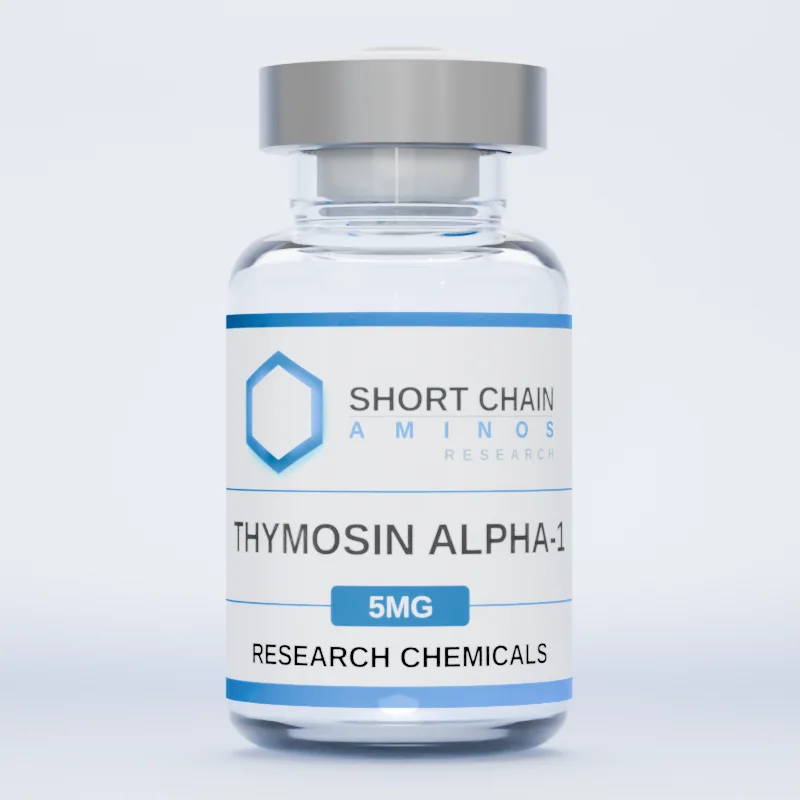
2. Thymosin alpha-1
An N-terminal 28-residue fragment of prothymosin alpha, first isolated from thymosin fraction 5 by Goldstein and colleagues in the 1970s. Synthetic material is known as thymalfasin.
3. KPV
The C-terminal three residues (Lys-Pro-Val) of α-MSH. It is studied as a minimal fragment of the parent sequence.
4. Glutathione
A thiol-containing three-residue molecule in which glutamate is linked through its γ-carboxyl group to cysteine, followed by glycine. The cysteine thiol cycles between the reduced form (GSH) and the disulfide form (GSSG), which makes glutathione a central redox buffer in cells.
5. NAD+
Nicotinamide adenine dinucleotide is an electron carrier that alternates between NAD+ and NADH, and a substrate consumed by sirtuins, PARPs and CD38.
6. Melanotan-2
A cyclic analog of α-MSH developed at the University of Arizona. Its lactam bridge constrains the core His-D-Phe-Arg-Trp pharmacophore and makes it a non-selective agonist across several melanocortin receptor subtypes.
7. Analytical characterization
Identity and purity are confirmed analytically for every lot. Reversed-phase HPLC with UV detection quantifies chromatographic purity, and electrospray mass spectrometry (ESI-MS) confirms that the observed molecular mass matches the theoretical value for each compound.
Results are reported on a lot-specific certificate of analysis together with appearance, net content and the lot number, which allows any vial to be traced back to its analytical record.
8. Storage and handling
Material is supplied as a lyophilized solid in a sealed vial. Unopened vials are best kept at −20 °C, protected from light and moisture. Allow a vial to equilibrate to room temperature before opening to limit condensation, and record the lot number so the vial can be matched to its certificate of analysis.
A lot-specific certificate of analysis is available for each batch.